- Veterinary View Box
- Posts
- A Breath of Trouble: TRALI Hits a Tiny Dog, But He Bounces Back!
A Breath of Trouble: TRALI Hits a Tiny Dog, But He Bounces Back!
Schweiz Arch Tierheilkd. 2025

Obi Veterinary Education
March 22, 2026
Pagnamenta S, Müller C, Meunier S, Dennler M, Glaus T
Background
Blood transfusions are essential in treating anemic dogs but carry risks, including respiratory complications such as transfusion-related acute lung injury (TRALI). TRALI, well-documented in human medicine, is rare in veterinary literature. This report describes a detailed case of TRALI in a dog following packed red blood cell (PRBC) transfusion, accompanied by transient pulmonary hypertension.
Methods
An 8-year-old male Chihuahua with severe, non-regenerative anemia was treated with a single PRBC transfusion. Following transfusion, the dog developed acute respiratory distress. Diagnostic assessments included thoracic radiography, echocardiography, bloodwork, and infectious disease testing. Supportive treatments included oxygen therapy, antibiotics, gastrointestinal protection, and sildenafil for pulmonary hypertension.
Results
Two hours post-transfusion, the dog developed dyspnea, cyanosis, and pulmonary crackles. Imaging and lab tests confirmed non-cardiogenic pulmonary edema and severe pulmonary hypertension, without cardiac enlargement or infectious causes. Echocardiography revealed right heart volume overload. Supportive care resulted in clinical and radiological resolution within days, with full normalization of pulmonary pressures by 3 weeks. The anemia did not recur over a 9-month follow-up.
Limitations
The report is limited to a single case, restricting generalizability. Lack of antibody testing and histopathology limits mechanistic insights. The cause of the initially elevated hematocrit post-transfusion remains speculative, attributed to hemoconcentration from pulmonary fluid shifts.
Conclusions
This case demonstrates that TRALI can occur after a single PRBC transfusion in dogs and may be complicated by transient pulmonary hypertension. Timely recognition and supportive management can lead to full recovery. Clinicians should be aware of TRALI as a potential, though rare, transfusion complication.
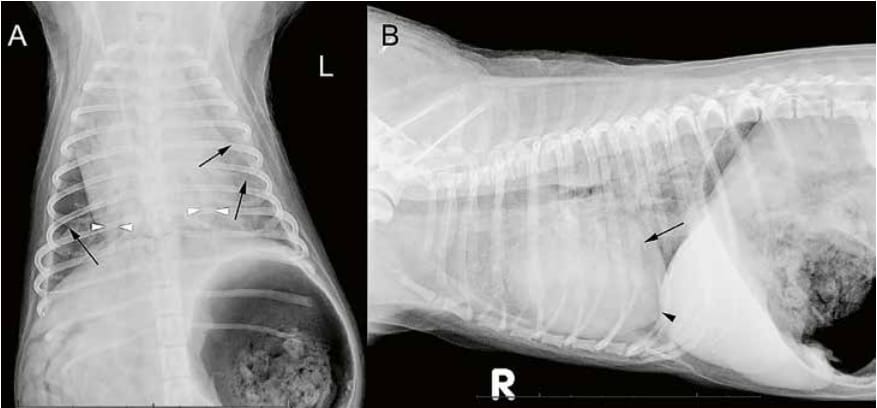
Thoracic radiographs of an 8-year-old intact male Chihuahua in two projections (A: ventrodorsal, B: left to right lateral projection). The images
were taken at the onset of dyspnea two hours after a blood transfusion. A small amount of fluid accumulates in the pleural space, separating the lung
surface from the parietal pleura and causing thin pleural fissure lines (small black arrows). The cardiac silhouette is moderately enlarged. It has a broad
sternal contact and a rounded right side that slightly elevates the cardiac apex (small black arrow head) from the sternum. The left side of the heart
appears small in volume. The caudal pulmonary arteries have a large diameter (white arrow heads). The pulmonary veins are largely masked by a
generalized severe unstructured interstitial lung pattern. The liver has an increased volume and the stomach contains a large amount of gas. The findings were interpreted as non-cardiogenic edema with pressure overload on the right side of the heart, mild secondary pleural effusion and aerophagia.
How did we do? |
Disclaimer: The summary generated in this email was created by an AI large language model. Therefore errors may occur. Reading the article is the best way to understand the scholarly work. The figure presented here remains the property of the publisher or author and subject to the applicable copyright agreement. It is reproduced here as an educational work. If you have any questions or concerns about the work presented here, reply to this email.