- Veterinary View Box
- Posts
- Are Veterinary Radiology Staff Really at Risk? New Data on Organ-Specific Radiation Doses
Are Veterinary Radiology Staff Really at Risk? New Data on Organ-Specific Radiation Doses
Radiation Protection Dosimetry 2025

Obi Veterinary Education
February 20, 2026
Joaquín Jiménez; Jose A. Corbacho; Pedro Escudero; Marta Púa; Coral Melchor
Background
The use of X-rays and computed tomography (CT) is integral to modern veterinary practice, particularly in equine and small animal medicine. Although animal exposures are generally lower than in human medicine, occupational exposure can occur when veterinary personnel restrain animals or operate portable radiographic equipment. Scattered radiation may result in non-negligible doses to critical tissues such as the hands, crystalline lens, chest, and gonads. Given the high workload at the Veterinary Clinical Hospital of the University of Extremadura (HCV-UEx), where approximately 7000 imaging procedures are performed annually, this study aimed to evaluate occupational equivalent doses to selected organs and tissues under simulated and real clinical conditions, including worst-case scenarios.
Methods
Three experimental scenarios were evaluated. Experiment 1 simulated portable equine radiography using anatomical specimens and measured scattered radiation at operator-relevant positions (hands, chest, crystalline lens) with and without protective equipment. Experiment 2 simulated routine small animal radiography (large and small canine cadavers) under worst-case exposure conditions, assessing doses to hands, chest, and crystalline lens. Experiment 3 measured scattered radiation during clinical CT examinations in the radiology room, focusing on gonadal and crystalline lens exposure at various operator positions. A calibrated ionization chamber radiometer (Radcal Accu-Pro system) was used for real-time exposure measurement. Organ equivalent doses were calculated using ICRP 116 conversion coefficients, assuming representative scattered radiation energies and conservative irradiation geometries. Annual equivalent doses were extrapolated based on institutional workload, assuming a single operator performed all procedures.
Results
In equine portable radiography, unprotected hands received the highest scattered radiation doses, with reductions of up to three orders of magnitude when lead gloves and cassette holders were used. The crystalline lens received the highest annual equivalent doses among assessed tissues, particularly during stifle projections, though values remained below regulatory limits. In small animal radiography, thoracic projections generated the greatest scattered radiation, followed by abdominal and limb examinations. Exposure was higher when holding large dogs compared with small dogs due to higher kilovoltage and larger irradiated fields. All protected measurements were below detection limits. In CT examinations, worst-case simulated operator positions without shielding produced measurable doses; however, annual extrapolated equivalent doses remained below the regulatory limit of 20 mSv per year for exposed workers. Institutional TLD monitoring confirmed low accumulated annual personal equivalent doses (Hp(10) and Hp(0.07)), well within regulatory thresholds.
Limitations
Simulated conditions were used in Experiments 1 and 2 to ensure controlled, repeatable, and ethically acceptable measurements, which may not fully reflect dynamic real-world clinical variability. Effective dose estimates relied on assumptions regarding scattered radiation energy and geometry and were provided only for contextual comparison, not for compliance assessment. Annual dose extrapolations were based on a conservative assumption that a single operator performed all procedures.
Conclusions
Occupational equivalent doses from scattered radiation in veterinary radiology vary according to procedure type, operator proximity to the primary beam, and protective practices. Portable equine radiography presents the highest exposure potential. Nevertheless, when appropriate radioprotection measures are applied, equivalent doses to critical tissues remain well below regulatory limits. Even under worst-case unprotected scenarios, doses per procedure were limited to the microSievert range. The findings reinforce the importance of strict adherence to radiation protection guidelines to minimize cumulative occupational exposure in high-workload veterinary settings.
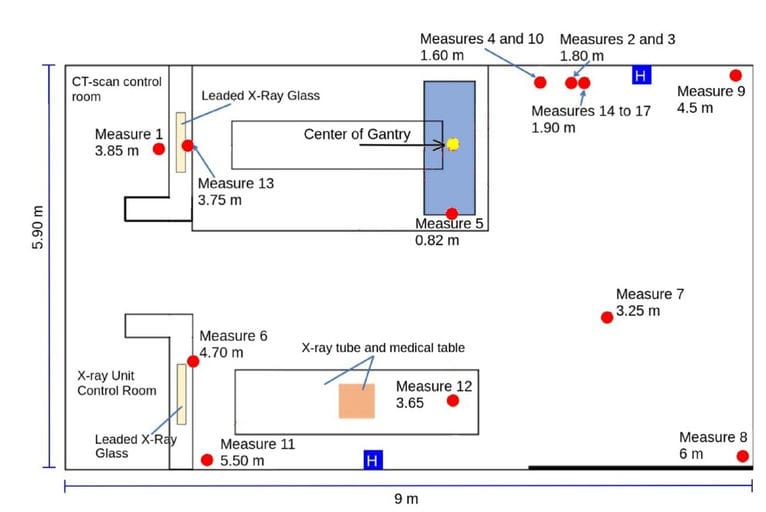
Schematic of the HCV-UEx radiology room, showing exposure measurements taken during CT-scan procedures. The squares marked with an ’H’ show the location of the area radiation monitors.
How did we do? |
Disclaimer: The summary generated in this email was created by an AI large language model. Therefore errors may occur. Reading the article is the best way to understand the scholarly work. The figure presented here remains the property of the publisher or author and subject to the applicable copyright agreement. It is reproduced here as an educational work. If you have any questions or concerns about the work presented here, reply to this email.