- Veterinary View Box
- Posts
- Clinical outcomes of legal antiviral therapy for FIP
Clinical outcomes of legal antiviral therapy for FIP
J Feline Med Surg. 2025

Obi Veterinary Education
February 01, 2026
S. Knies et al.
Introduction
Feline infectious peritonitis (FIP) was historically fatal until the advent of antivirals. Following legalization of GS-441524 in the Netherlands, prospective data on real-world treatment outcomes were needed to assess efficacy, safety, and prognostic factors.
Materials and Methods
Prospective multicentre clinical study of 127 client-owned cats with confirmed or suspected FIP treated with oral GS-441524 ± intravenous remdesivir. Standardized diagnostic criteria, dosing protocols, monitoring schedules, and outcome measures were applied across centers.
Results
Overall survival was ~78–80%, with survival strongly dependent on early response. Cats surviving the first 8 days had a 98% one-year survival rate. Ocular FIP carried the best prognosis, while neurological FIP had lower survival. Elevated bilirubin and creatinine at presentation were negative prognostic indicators. Adverse effects were mild and primarily gastrointestinal.
Limitations
Short follow-up in some cases, heterogeneous disease severity, and reliance on clinical rather than virologic confirmation in all suspected relapses.
Conclusion
Legally prescribed GS-441524 is highly effective and well tolerated. Early disease severity, rather than treatment failure, determines outcome. Structured monitoring is critical to distinguish relapse from transient abnormalities.
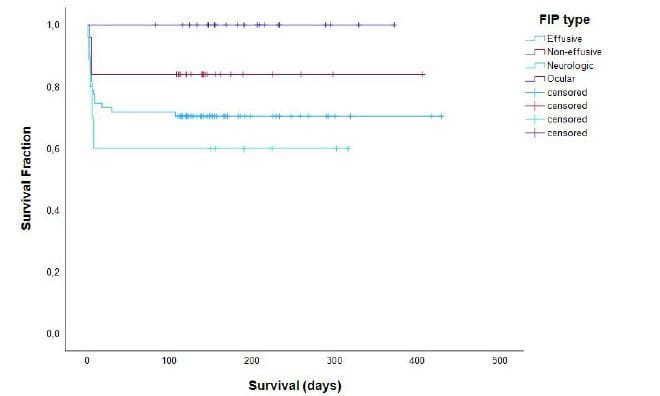
Kaplan-Meier curves for 127 cats with FIP treated with nucleoside analogues GS-441524 with
417 or without remdesivir for the different types of FIP. The vertical bars demonstrate censored
418 observations.
How did we do? |
Disclaimer: The summary generated in this email was created by an AI large language model. Therefore errors may occur. Reading the article is the best way to understand the scholarly work. The figure presented here remains the property of the publisher or author and subject to the applicable copyright agreement. It is reproduced here as an educational work. If you have any questions or concerns about the work presented here, reply to this email.