- Veterinary View Box
- Posts
- Successful Dialysis Reverses Severe Lung Complications in Canine AKI Case
Successful Dialysis Reverses Severe Lung Complications in Canine AKI Case
Vet Med Sci. 2026

Obi Veterinary Education
March 29, 2026
Se-Hoon Kim, Jun-Hyeong Park, Yoon-Soo Jeong, Seo-Yeon Park, Sung-Ryoung Kim, Min-Ok Ryu, Ji-Hye Choi, Kyoung-Won Seo
Background
This case report describes the relationship between acute kidney injury (AKI), uraemia, and pulmonary complications in dogs. Uraemia can increase pulmonary vascular permeability, predisposing to noncardiogenic pulmonary oedema, uraemic pneumonitis, and acute respiratory distress syndrome (ARDS). Despite recognition of these associations, detailed veterinary reports documenting progression and treatment response—particularly with haemodialysis—remain limited.
Methods
A 7-year-old Poodle with severe AKI, likely induced by firocoxib, was managed with intravenous fluids, diuretics, and ultimately haemodialysis due to persistent oliguria. Serial diagnostics included bloodwork, thoracic radiography, and clinical monitoring of respiratory status. Differential diagnoses for pulmonary complications included noncardiogenic pulmonary oedema, uraemic pneumonitis, ARDS, and transfusion-related lung injury.
Results
Following initiation of haemodialysis, the dog developed acute tachypnoea and progressive bilateral pulmonary infiltrates consistent with noncardiogenic pulmonary oedema. Despite improvement in biochemical parameters after dialysis, respiratory abnormalities persisted initially. After three haemodialysis sessions, urine output improved to polyuria and uraemia decreased. Pulmonary infiltrates gradually resolved radiographically by Day 7 and completely by Day 18, with clinical resolution of tachypnoea by Day 12.
Limitations
Definitive diagnosis was limited by lack of arterial blood gas analysis, absence of bronchoalveolar lavage, and incomplete exclusion of infectious causes such as leptospirosis. Additionally, diagnostic criteria for uraemic pneumonitis in veterinary medicine are not well established, and interpretations relied partly on human literature.
Conclusions
This case highlights the complex interaction between AKI, systemic inflammation, and pulmonary complications in dogs. Haemodialysis, while primarily targeting uraemia, was associated with gradual resolution of pulmonary pathology. The findings emphasize the importance of addressing the underlying uraemic state and carefully managing fluid therapy in patients at risk of noncardiogenic pulmonary oedema or ARDS.
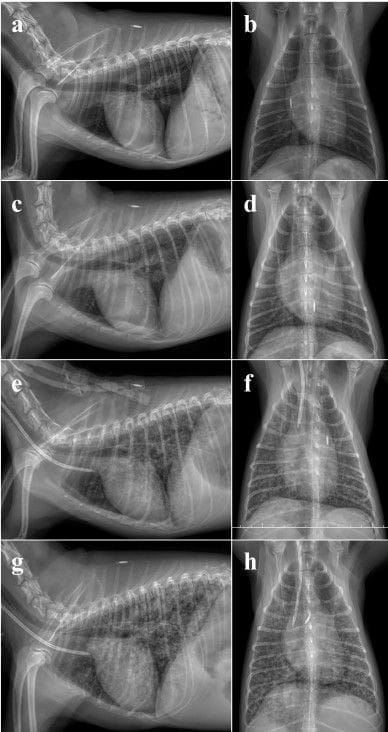
2Sequential radiographic evaluation of a 7-year-old female dog diagnosed with acute kidney injury (AKI) from Days 0 to 3. Lateral and ventrodorsal views were taken. (a, b) On Day 0, when diagnosed with AKI, no significant findings were detected in the thoracic radiographs, including the heart and lungs. Localised high-density foci in the lungs indicated pulmonary osteoma. (c, d) On Day 1, early pulmonary changes of mild interstitial infiltration were noted in the bilateral caudal lung lobes, causing a slightly indistinct margin of the pulmonary vasculature. (e, f) The radiographs of Day 2, post-dialysis imaging, revealed progression of pulmonary changes, showing a marked increase in the bronchointerstitial pattern along with diffuse alveolar infiltrates in the bilateral caudal lobes, obscuring the margins of the heart and pulmonary vessels. The presence of an oesophageal tube in the cervical region was found. The patterns and distribution of lung infiltrates indicated uraemic pneumonitis with noncardiogenic pulmonary oedema. (g, h) On Day 3, extensive pulmonary infiltration was observed throughout the lung fields, indicating a widespread involvement
How did we do? |
Disclaimer: The summary generated in this email was created by an AI large language model. Therefore errors may occur. Reading the article is the best way to understand the scholarly work. The figure presented here remains the property of the publisher or author and subject to the applicable copyright agreement. It is reproduced here as an educational work. If you have any questions or concerns about the work presented here, reply to this email.